User profiles
A user profile is a set of settings for the Vipilink agent and the Vipilink web platform. You assign each profile to one or more groups, and everyone in those groups gets its settings. Use profiles to give different teams different rules, for example Always-On VPN for remote staff and a shorter sign-in time for contractors.
Go to Team → User Profiles to see your profiles.

Every workspace starts with a Default Profile assigned to All Users. You can edit it, but you can't rename or delete it. Use the pencil icon to edit a profile, the copy icon to duplicate it and the trash icon to delete it.
Which profile a user gets
A user can be in several groups, so more than one profile can match them. Vipilink checks profiles in order of Priority, starting from 1, and applies the first one that matches. A lower number means a higher preference.
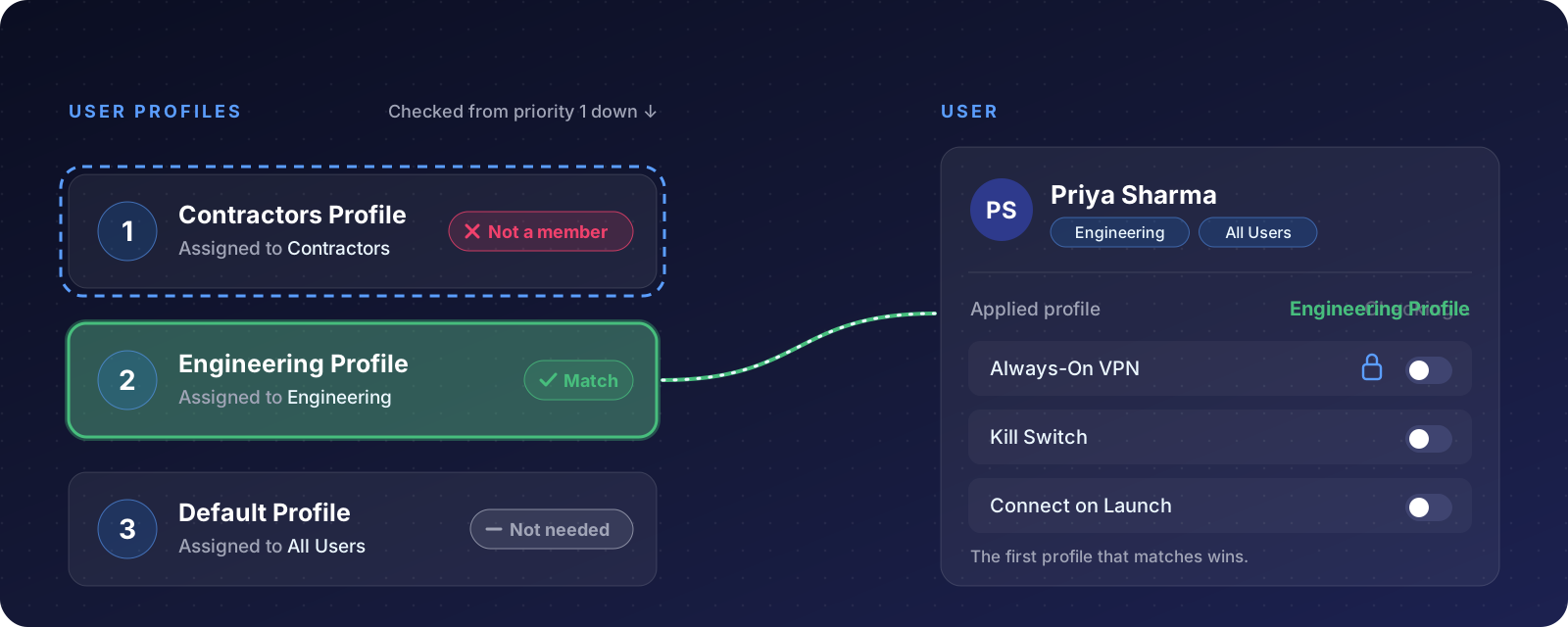
In this example, Priya Sharma is in the Engineering and All Users groups. Priority 1 is for Contractors, so it doesn't match. Priority 2 is for Engineering, so Priya gets the Engineering Profile. The Default Profile at priority 3 also matches, but it isn't needed.
To change the order, drag a profile up or down by its priority number. Keep the most specific profiles at the top and the Default Profile at the bottom, so it only applies to people no other profile covers.
Create a profile
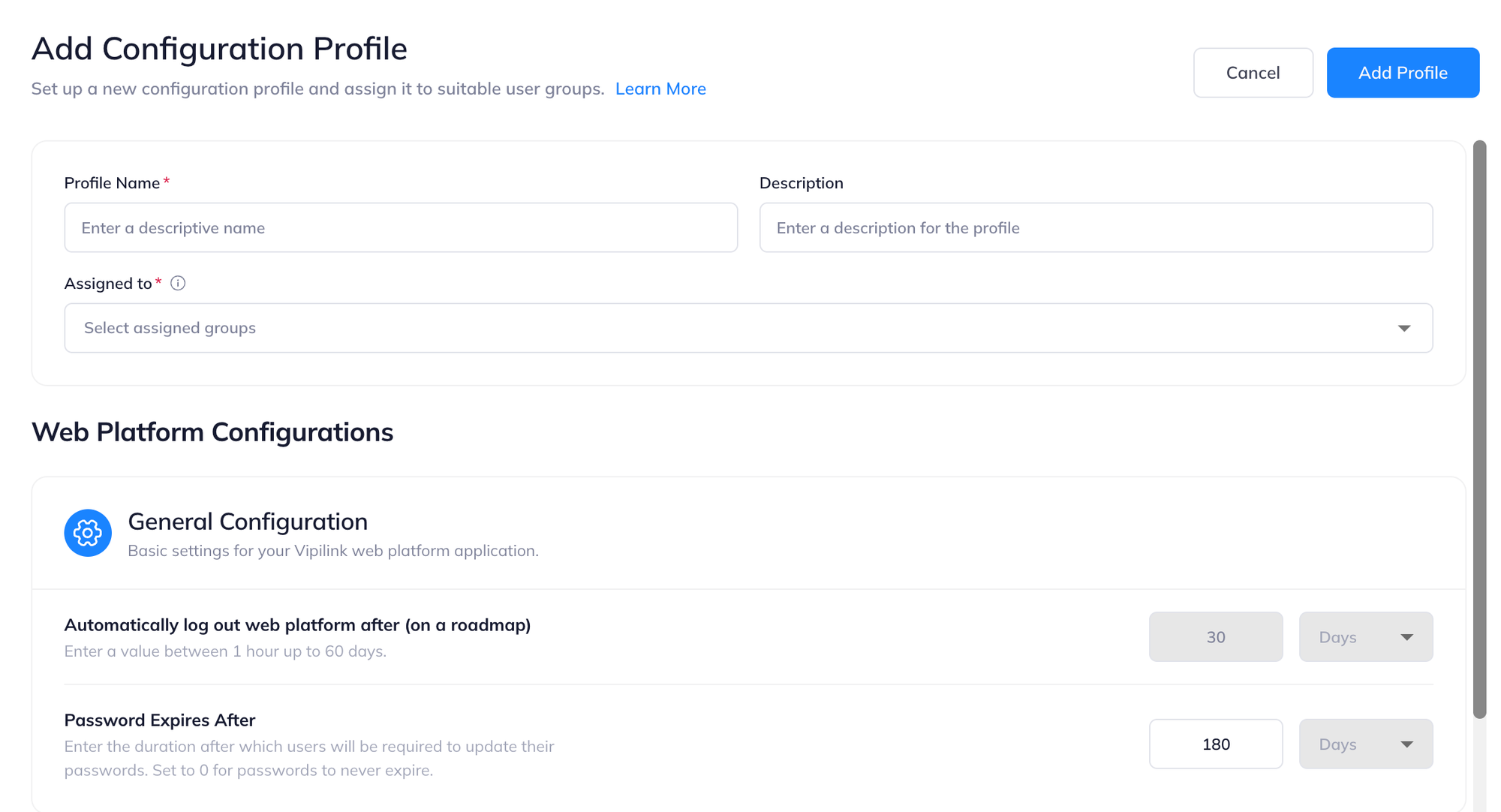
- On the User Profiles page, click Add Profile.
- Enter a Profile Name and, if you like, a Description.
- In Assigned to, choose the groups that get this profile.
- Set the options in each section below.
- Click Add Profile.
Web platform settings
These apply when users sign in to the Vipilink web platform.
| Setting | What it does |
|---|---|
| Password Expires After | How long a password stays valid before the user must change it. Set it to 0 so passwords never expire. |
| Automatically log out web platform after | Coming soon. |
Agent settings
These apply to the Vipilink agent on users' devices.
Lock a setting
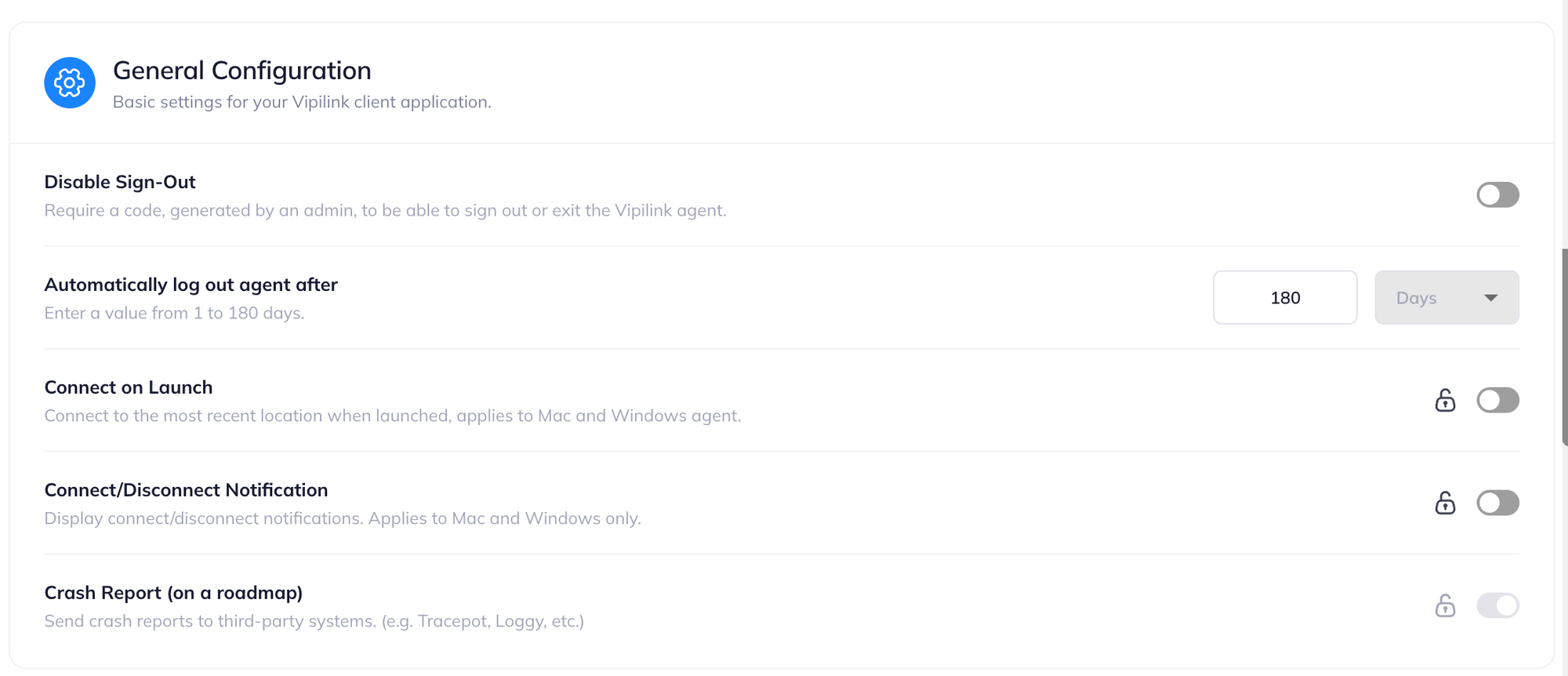
Many agent settings have a lock icon next to them. Click it to lock the setting: users then see it as Set by Admin in the agent and can't change it. Unlocked settings are only defaults, and users can change them in the agent's Settings.
| Setting | What it does |
|---|---|
| Disable Sign-Out | Users can't sign out of the agent on their own. They need a code that an admin creates. See Generate a sign-out code. |
| Automatically log out agent after | Signs the user out of the agent after this many days, from 1 to 180. |
| Connect on Launch | When the agent starts, it connects to the network the user used last. Mac and Windows. |
| Connect/Disconnect Notification | Shows a notification when the agent connects or disconnects. Mac and Windows. |
| Crash Report | Coming soon. |
Automatic VPN connection
Turn on Automatic VPN Connection to have the agent connect without the user clicking Connect. Then choose one of two modes.
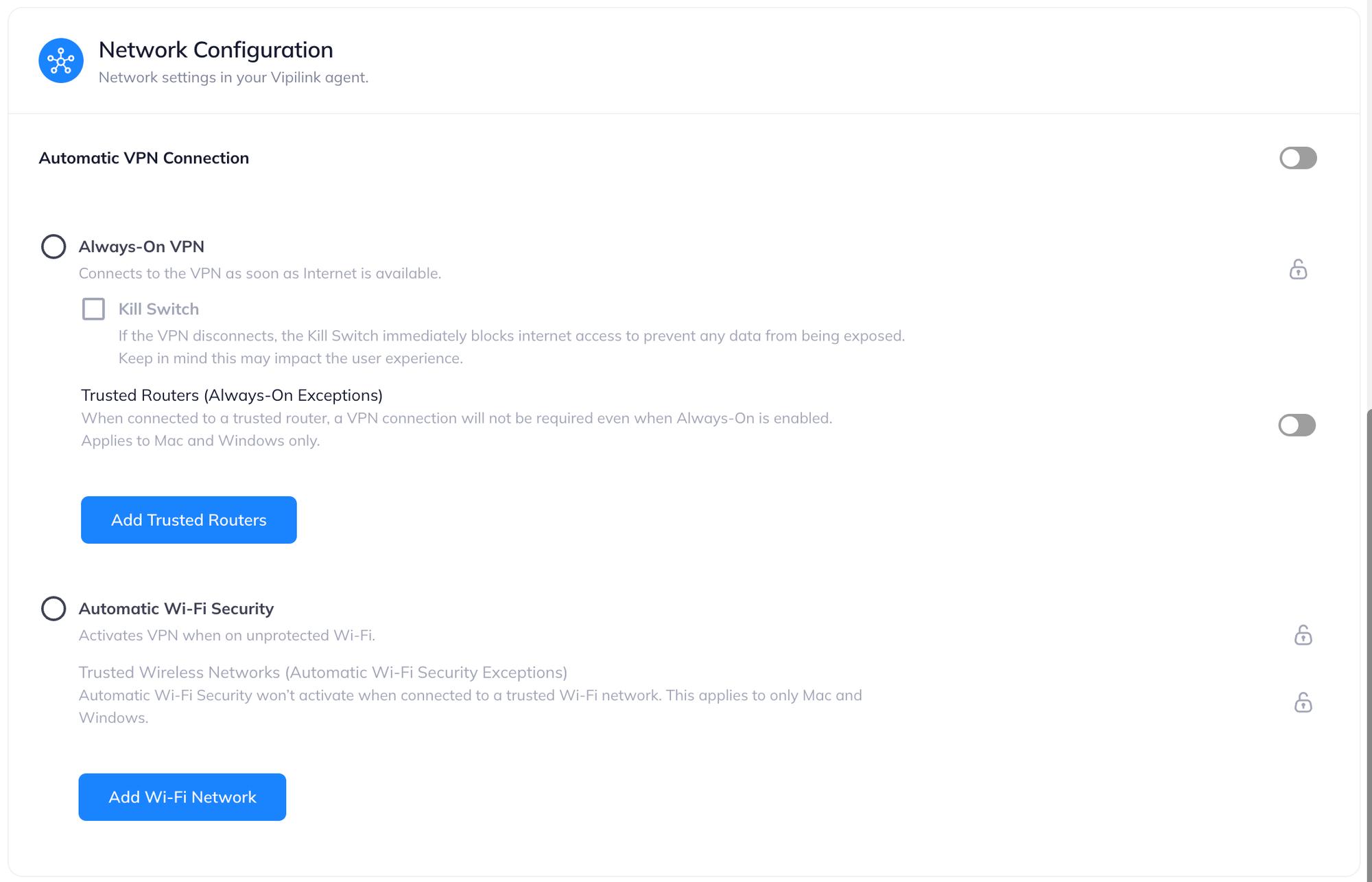
The agent connects as soon as the device has internet, and stays connected.
- Kill Switch: if the VPN drops, the device's internet access is blocked until the VPN is back, so no traffic leaves unprotected. This can interrupt users' work while the VPN reconnects.
- Trusted Routers: routers where the VPN isn't required, for example your office network. Click Add Trusted Routers to add them. Mac and Windows.
The agent connects when the device joins an unprotected Wi-Fi network, for example in a café or an airport.
- Trusted Wireless Networks: Wi-Fi networks where the agent doesn't connect automatically. Click Add Wi-Fi Network to add them. Mac and Windows.
Agent upgrades
Choose how the agent upgrades when a new version is out, separately for Windows, Mac and Linux.
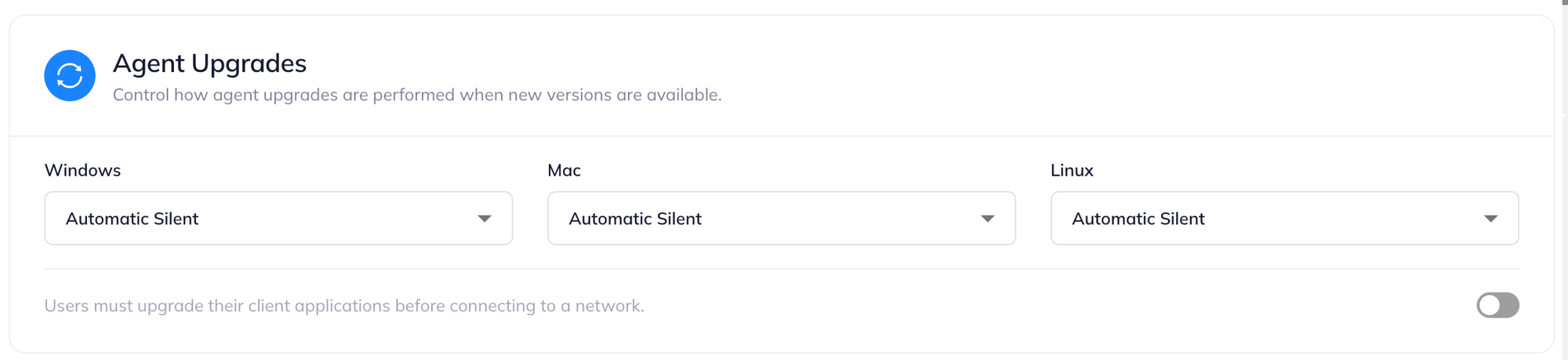
| Option | What happens |
|---|---|
| Automatic Silent | The agent upgrades on its own without asking. |
| Notify Users | Users get a notification before the agent upgrades. |
| Disabled | The agent doesn't upgrade. |
Turn on Users must upgrade their client applications before connecting to a network to block older agents from connecting until they're upgraded.
Platform settings
Each operating system has its own settings.
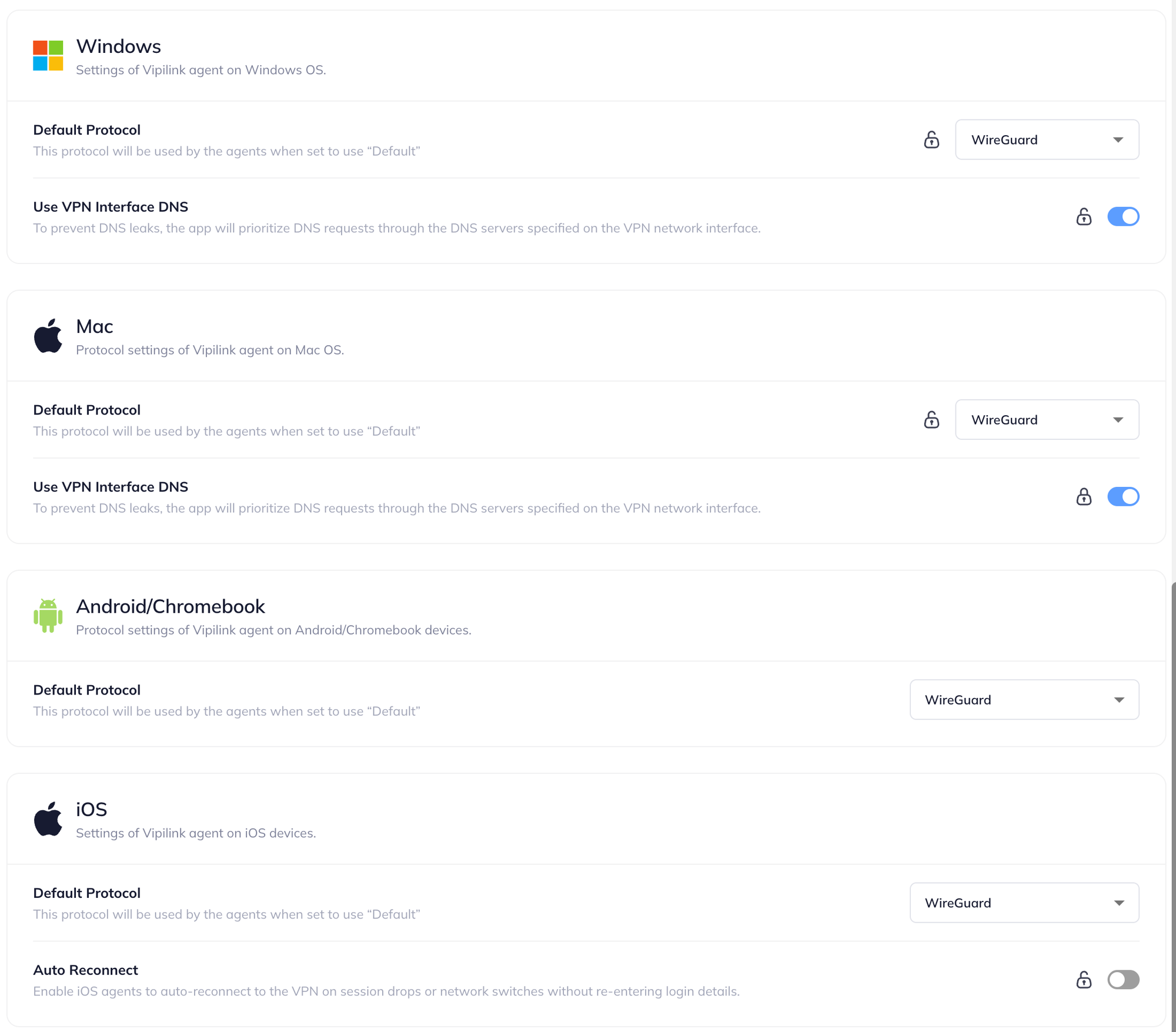
| Setting | Platforms | What it does |
|---|---|---|
| VPN Protocol | All | The VPN protocol the agent uses to connect. Windows and Mac can use WireGuard or OpenVPN. iOS and Android use WireGuard only. WireGuard is the default. Lock it if users shouldn't change it in the agent. |
| Use VPN Interface DNS | Windows, Mac | Sends DNS requests to the DNS servers of the VPN connection first, to prevent DNS leaks. |
| Auto Reconnect | iOS | Reconnects the VPN on its own when the connection drops or the device switches networks, without signing in again. |